Background#
At Nexus, our sales team spends a lot of time researching potential game publishers before reaching out. For every lead, someone has to dig into the publisher’s games, check if they have a webshop, look for existing creator programs, see what the social buzz and influencer ecosystem is like, track down contacts on email or LinkedIn, and piece together whether the opportunity is worth pursuing. It’s time-consuming, necessary work to help qualify a game as a good fit for our creator programs, but it can take an hour or more per publisher.
I wanted to see if we could collapse that research cycle down to minutes using AI. The premise: give the tool a game name, and let it do all the legwork. Dig into the company, analyze the game’s monetization, check for creator programs, gauge social buzz, find contacts, draft outreach emails, and score the opportunity.
What It Does#
Scout covers the full pipeline from finding prospects to researching them to reaching out:
- Prospecting pulls in trending and relevant games from Sensor Tower (mobile) and Steam APIs (PC) on a schedule, giving the team a constantly refreshed list of potential targets to evaluate
- Deep Research dispatches a team of AI agents to investigate a game and its publisher in parallel, producing a scored dossier in minutes
- Contact Enrichment discovers key people at the company, finds their email addresses, and verifies deliverability
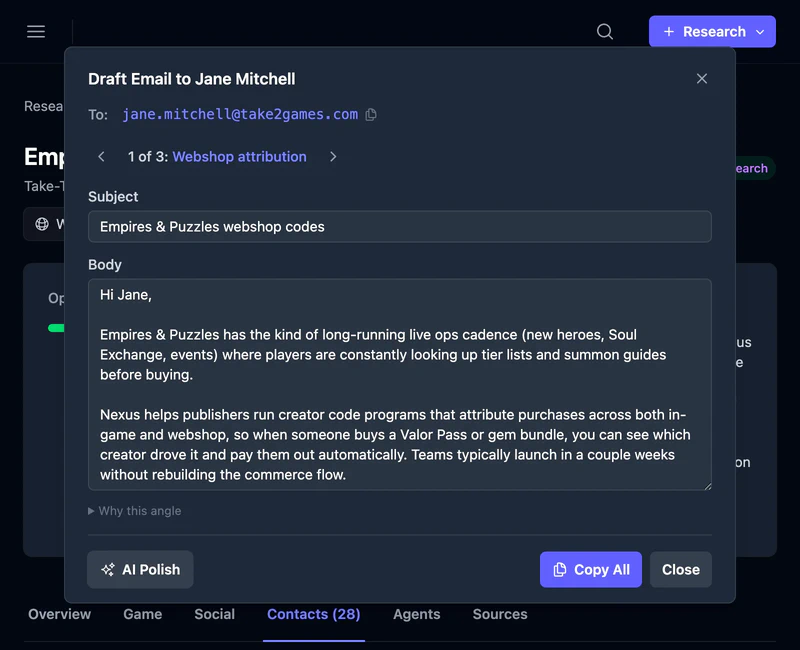
- Email Drafting generates personalized outreach emails using the research it already gathered, with multiple angle variations per contact
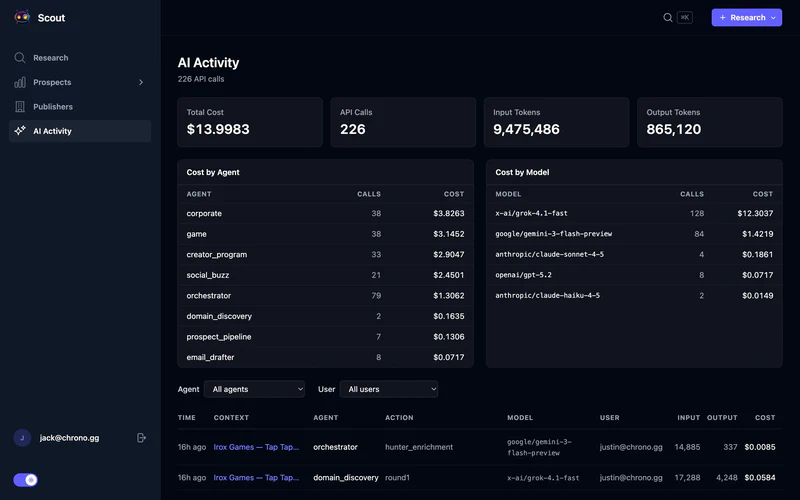
- AI Tracking logs every API call with usage and costs so we can see exactly what each research run costs
Each piece feeds into the next. A game shows up in Prospects, the team kicks off research, contacts get enriched, and the rep drafts an email.
Prospecting#
Scheduled jobs pull in data from two sources: Sensor Tower for trending mobile games and the Steam API for new global releases and top free-to-play titles. These populate the Prospects tab with an initial score and basic info so salespeople can quickly scan for games that look like a good fit. From there, one click kicks off a full deep research or a lighter contacts-only enrichment.
Deep Research#
Scout dispatches four AI research agents with web search enabled in parallel:
- Corporate Intel discovers the publisher’s headquarters, company size, parent company, website, social channels, and key contacts
- Game Analysis digs into the specific game’s monetization model, player base, purchase channels, and whether they have a webshop
- Creator Program Discovery searches for existing support-a-creator programs, affiliate links, or influencer partnerships
- Social Buzz gauges community sentiment across Reddit, Discord, YouTube, and other channels
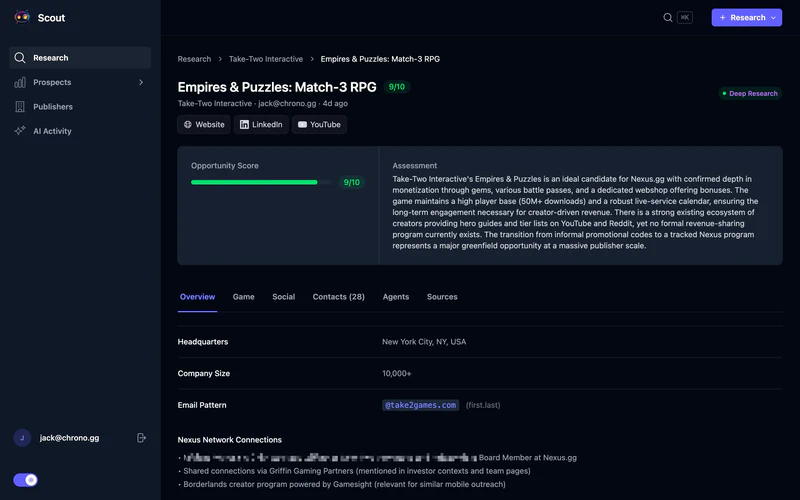
Each agent gets extensive context about our business, our investor network, existing customers, and key partnerships. So when it researches a publisher, it can flag warm connections, like a shared investor or a board member who already works with that company. The agents search the web, cross-reference sources, and a final agent pulls everything together into a report with an opportunity score from 1 to 10.
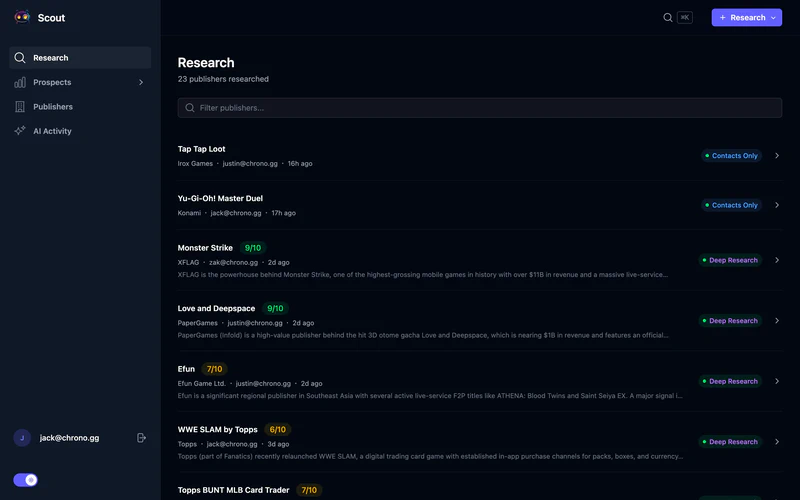
Each result is a full report. You get the opportunity score with an AI-written assessment, tabbed sections for the overview, game details, social analysis, and discovered and enriched contacts. Everything is cited with sources so the sales team can verify and dig deeper.
Contact Enrichment#
After research completes, an AI agent discovers the company’s email domain and pattern, then finds relevant contacts by searching LinkedIn, company websites, and public directories. It prioritizes people in marketing, business development, and partnerships, and ranks them by how likely they are to be the right person to talk to.
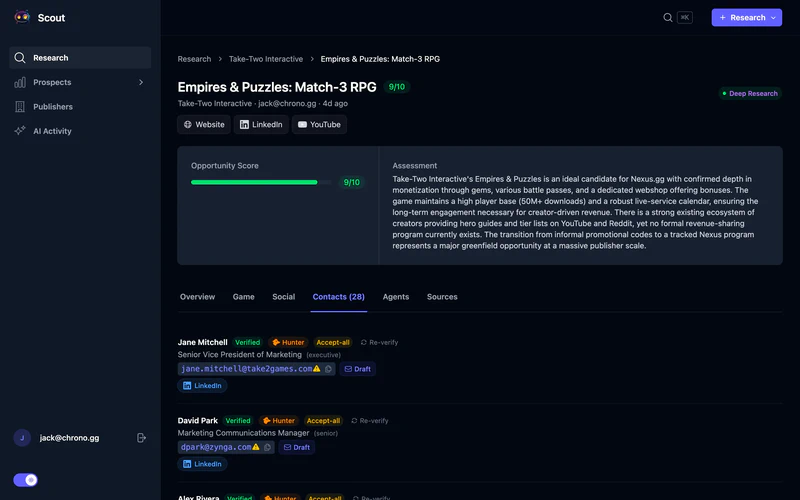
Once contacts are found, Scout verifies their email addresses through Hunter.io. Each contact gets tagged with a verification status so the team knows which emails are confirmed deliverable versus estimated. The whole process turns “we should reach out to this publisher” into “here are 28 verified contacts with their titles and LinkedIn profiles” without anyone having to manually search.
All contact names and email addresses shown are anonymized for demo purposes. Real data is not presented. Names and emails are swapped, randomized, or generated, and do not represent actual individuals.
Email Drafting#
From the contacts list, the team can hit “Draft” on any contact and Scout generates a personalized outreach email using the research it already gathered. The drafter writes multiple angle variations, each tailored to the specific game and the contact’s role. It pulls in what the game monetizes, whether they have a webshop, and what gaps exist in their creator program.
Publisher Database#
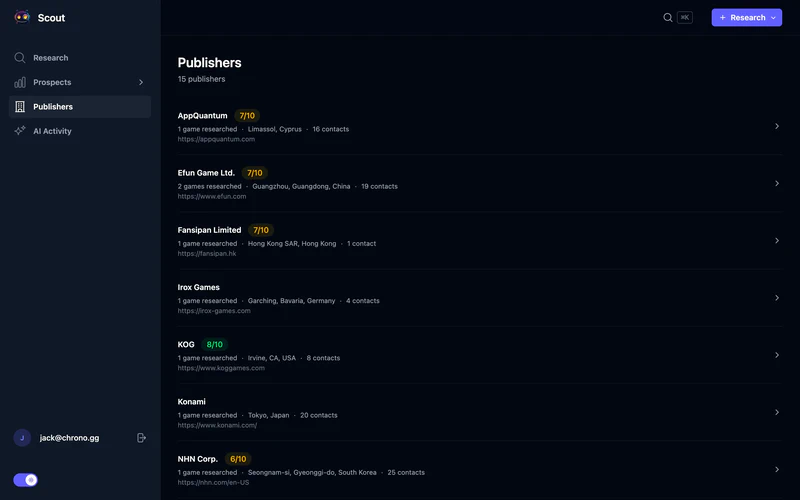
As research accumulates, Scout builds a publisher database automatically. Company-level data like headquarters, email patterns, and contact lists are shared across all game researches for the same publisher. This means the second time you research a game from the same publisher, Scout already knows the company and can focus on the game-specific details.
AI Activity Tracking#
Scout logs every AI call by agent, model, and cost. We can see exactly what each research run costs and track overall spend in the dashboard.
Slack Integration#
Scout also lives in Slack. A /scout-research slash command opens a modal where you type in a game name, and the results get posted back as a threaded message.
How It Was Built#
- Python and FastAPI for the backend, powering both the web UI and the service that runs the AI agents. Tailwind CSS for the frontend styling
- Multiple AI providers including Claude, Gemini, OpenAI, and Grok, with web search built into the research queries. OpenAI handles the email drafting, while the research agents rotate between models depending on the task.
- Google Cloud Platform for infrastructure, secured behind Google Workspace logins since it’s an internal tool. Cloud Run for the web and worker services (containerized with Docker), Cloud SQL for the database, Cloud Tasks for background jobs, and a Cloud Function for handling Slack events
- PostgreSQL stores all the research data, company records, contacts, and activity logs
- Hunter.io for email discovery and verification
- Terraform manages all the infrastructure as code
- Slack Bolt for the bot integration with slash commands and modal forms
- GitHub Actions for CI/CD, running tests and deploying on every push
The whole system scales to zero when idle and costs about $7/month at rest. Research runs happen in the background, so kicking off a deep dive doesn’t block anything.
Built with Claude Code.